
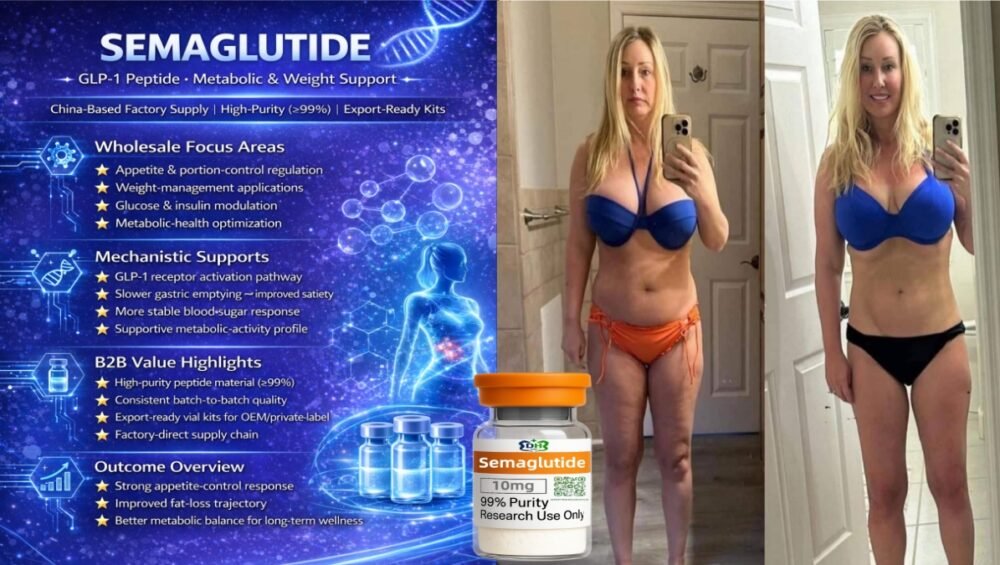
Semaglutide peptide wholesale overview
Semaglutide has become one of the highest-demand GLP-1 peptides in the global market. For factory-facing and wholesale buyers, the key questions are no longer “what is it”, but rather how to structure stable supply, manage quality documentation and keep export logistics under control when working with a China-based peptide factory.
This guide walks through the Semaglutide peptide from a wholesale and B2B perspective: where it usually sits in a GLP-1 portfolio, which formats are most practical, what to check on COA and batch docs, and how to talk about pricing, routes and risk with your supplier.
1. What Semaglutide means in a GLP-1 wholesale portfolio
For most distributors and project owners, Semaglutide is the anchor of a GLP-1 product family. It often sits next to Tirzepatide, Retatrutide, Survodutide or Cagrilintide-based blends and is used as the reference point for quality, pricing and demand forecasts.
- Demand driver: high global interest around GLP-1 research and weight-management related projects.
- Role in your lineup: a core GLP-1 peptide that can support both retail-facing brands and B2B formulation projects.
- Benchmark molecule: many buyers use Semaglutide as the benchmark when comparing other GLP-1 analogues.
Because Semaglutide is so visible, the way you source it from a factory will strongly influence how buyers perceive the rest of your GLP-1 range.
2. Common Semaglutide research formats & kit structures
On the wholesale side, Semaglutide is usually supplied as a high-purity (≥99%) lyophilized peptide powder in clear glass vials. Exact strengths vary by supplier, but kit structures typically follow a few familiar patterns.
- Typical vial strengths: small to medium milligram amounts per vial, suitable for research-use-only projects.
- Standard kit size: many factories offer 10-vial kits as a base configuration, which is convenient for sampling and distribution.
- Labeling and artwork: neutral factory artwork for bulk buyers, or OEM / private-label designs for brand owners.
When you discuss formats with a factory, it is useful to separate three layers clearly:
- Core peptide spec: purity level, peptide content, residual solvent and related-peptide profile.
- Vial and kit format: vial size, stopper and cap color, number of vials per kit, carton style.
- Brand layer: whether you need plain factory labels or custom OEM artwork for your own brand.
3. Quality, COA and batch documentation for Semaglutide
Because Semaglutide is a high-profile peptide, buyers should treat documentation as non-negotiable. Ask the factory to show you a representative certificate of analysis before committing to large orders and make sure your contract mentions documentation per batch.
- Core COA items: identity testing, purity (preferably ≥99%), related substances, water content and residual solvents.
- Batch traceability: clear batch numbers, manufacturing dates and internal reference codes.
- Stability notes: recommended storage conditions (normally 2–8 °C, protected from light and moisture).
For larger or recurring projects, many buyers also request supplementary documents such as method summaries, technical data sheets or brief QC process descriptions. The more clearly this is defined at the start, the smoother future shipments tend to be.
4. Shipping, export routes and packaging from China
From a logistics perspective, Semaglutide kits are usually shipped as non-finished, research-use-only peptide materials. That means routing and packaging decisions are just as important as the peptide itself when you work with a China-based factory.
- Packaging: export-ready boxes with shock-absorbing inserts, sealed kits and moisture protection for the vials.
- Routes: different lines may be used for different regions (for example, one route for North America and another for EU / UK).
- Temperature handling: discuss realistic transport conditions and whether your lane needs additional insulation or faster transit times.
Professional suppliers typically provide tracking once parcels are processed. A reasonable expectation is that processing and dispatch updates are provided within around three business days after payment for regular batches.
5. Semaglutide wholesale pricing, MOQs and quote requests
Semaglutide pricing can move faster than most classic peptides, so buyers should treat quotes as time-sensitive and always ask what factors influence future price changes. Instead of pushing only for the lowest number, it is often more useful to focus on structure and transparency.
- Clarify volume tiers: ask how pricing changes between pilot orders, mid-size orders and full-scale bulk runs.
- Separate core cost and services: distinguish between pure peptide cost and optional extras such as OEM artwork, custom packaging or special logistics routes.
- Ask for example quotes: request a few concrete scenarios (for example, different kit counts or mixed GLP-1 orders) so you can compare offers cleanly.
When you email a factory for Semaglutide quotes, include at least: intended order size range, preferred vial / kit format, target region for shipping and whether you plan to repeat orders if the first batch performs well.
6. Risk control when choosing a Semaglutide supplier
Because Semaglutide is a high-demand item, the market also attracts opportunistic traders. A basic risk-control checklist can protect your budget and reputation.
- Check identity: verify company details, registration information and basic track record, not just a chat handle.
- Cross-check documentation: look for inconsistencies across COA, packaging photos and communication.
- Start with realistic pilot orders: avoid committing your full annual budget on the first shipment.
- Align payment terms with risk: safer routes and factories with a history of on-time deliveries may justify more flexible terms; unknown suppliers usually do not.
Serious factories understand that B2B buyers need to ask detailed questions. The way a supplier responds to structured questions about Semaglutide is often a good indicator of how they will handle future GLP-1 projects for you.
7. How Semaglutide fits with other GLP-1 peptides
Most wholesale portfolios do not carry Semaglutide alone. Instead, it is positioned inside a small GLP-1 family that might also include Tirzepatide, Retatrutide, Survodutide or Cagrilintide-based blends. Working with one factory for the full GLP-1 lineup can simplify quality control and logistics.
- Shared specs: similar purity expectations and documentation formats across multiple GLP-1 peptides.
- Coordinated production: the factory can align production windows to prepare mixed GLP-1 shipments.
- Portfolio-level pricing: some suppliers provide better overall conditions when buyers plan a structured GLP-1 lineup instead of isolated one-off orders.
Related products & GLP-1 peptide lineup
- Semaglutide – GLP-1 peptide kit
- Tirzepatide – GLP-1/GIP peptide kit
- Retatrutide – GLP-1 peptide kit
- Survodutide – GLP-1/GIP analogue kit
- Cagrilintide 5 mg + Semaglutide 5 mg – combo GLP-1 peptide kit
- Browse all Weight Loss & GLP-1 Peptides
FAQ: Semaglutide wholesale from a China-based factory
Q1. Is this article giving dosing or medical advice?
No. This guide focuses only on B2B wholesale planning, supply-chain structure and documentation. It does not provide dosing instructions, medical guidance or patient recommendations.
Q2. Are Semaglutide products discussed here sold for human use?
No. Semaglutide and other peptides mentioned are supplied strictly as research materials. They are not labeled or promoted for human consumption, therapy or diagnostic use.
Q3. Can one factory handle my whole GLP-1 lineup?
In many cases, yes. If the manufacturer already produces Semaglutide, they may also support Tirzepatide, Retatrutide, Survodutide or related combinations. Consolidating your GLP-1 portfolio at a single factory can simplify quality control and logistics discussions.
Q4. How often can pricing change for Semaglutide?
Pricing can move with raw material cost, demand and regulatory factors. It is reasonable to confirm that each quote has a validity period and to review conditions again before placing significantly larger orders.
DISCLAIMER: This article is intended for B2B wholesale and research-chemical planning only. It does not provide medical advice, dosage guidance or recommendations for human use.
All products discussed are supplied as research materials only and are not labeled for human consumption or medical use.
 EN
EN  DE
DE 

