Free standard shipping for orders over $500.  WhatsApp: +852 44900019  
Telegram: @PeptideSourceHub  · Email: wholesale@peptidesourcehub.com

Blog

Peptides&HGH

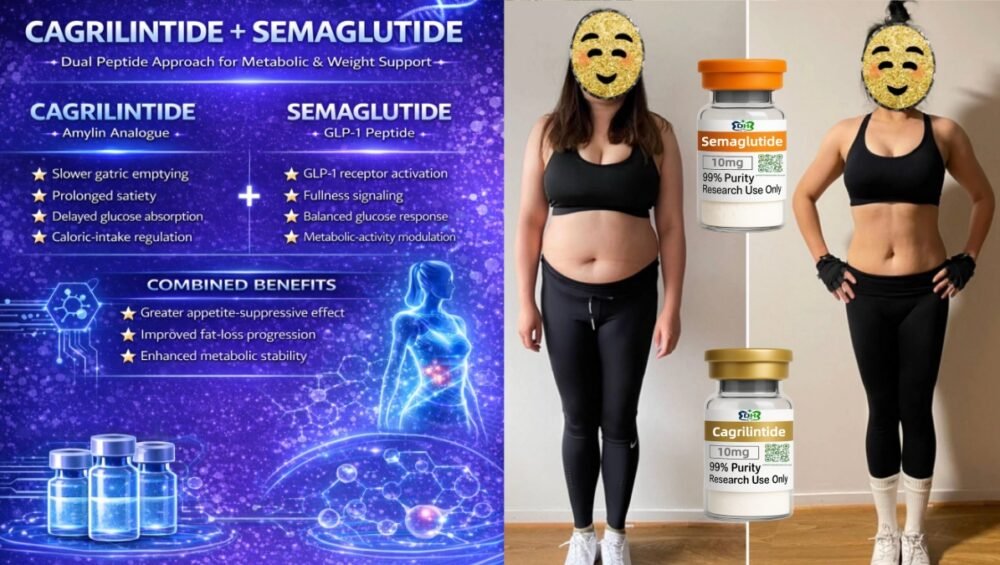
Cagrilintide plus Semaglutide dual peptide stack with before and after figure

Cagrilintide + Semaglutide Stack: How Wholesale Buyers Plan Dual-Peptide Portfolios

Cagrilintide + Semaglutide: Planning a Dual-Peptide GLP-1 Stack

Many wholesale buyers who start with single-molecule GLP-1 projects eventually ask the same question: what happens if we combine appetite-support from two different pathways? That is where a fixed dual-peptide kit such as Cagrilintide 5 mg + Semaglutide 5 mg becomes interesting for portfolio planning.

Different Roles in the Same Stack

In most project designs, Semaglutide is treated as the GLP-1 backbone, while Cagrilintide is used to tighten satiety and caloric-intake control:

  • Semaglutide: GLP-1 receptor activation, appetite signalling, balanced glucose response, and overall metabolic-activity support.
  • Cagrilintide: slower gastric emptying, prolonged fullness and smoother caloric-intake patterns.

By sourcing both from the same China-based factory – for example Semaglutide peptide kits plus dedicated Cagrilintide kits – buyers can explore each molecule separately before locking in a fixed dual-peptide protocol.

Why Some Buyers Move Toward a Dual-Peptide Approach

There are a few recurring reasons why B2B customers add a Cagrilintide + Semaglutide stack to their GLP-1 portfolio:

  • Existing GLP-1 projects show good response, but teams want stronger appetite-control signals and better day-to-day satiety stability.
  • OEM and private-label brands are looking for a premium “enhanced satiety” or “next-step” program above standard GLP-1 options.
  • Internal R&D groups want to understand how amylin-pathway support changes long-term weight-management trajectories.

Instead of running two fully separate supply chains, a single factory-made kit with pre-defined strengths is often easier to standardise and document.

Typical Study and Portfolio Scenarios

In practice, buyers rarely jump straight into dual-peptide work without preparation. A common roadmap looks like this:

  1. Start with Semaglutide-only projects to understand GLP-1 behaviour and documentation requirements.
  2. Add single-molecule Cagrilintide kits into pilot models that focus on satiety and caloric-intake tracking.
  3. Once internal data is consistent, migrate to a fixed dual-peptide format such as Cagrilintide 5 mg + Semaglutide 5 mg vials for larger cohorts or OEM roll-outs.

This step-by-step approach makes it easier to separate the contribution of each peptide, while still ending with a simple kit format for export and routine re-ordering.

Operational Considerations for Dual-Peptide Kits

From a logistics point of view, dual-peptide projects benefit from the same discipline as single-molecule work:

  • Use clear batch coding and keep GLP-1 and amylin components traceable in your records.
  • Align storage conditions (2–8 °C, dry and dark) for all related vials and reference standards.
  • Keep COA, HPLC data and other quality documentation accessible for both Cagrilintide and Semaglutide components, especially for OEM and regulatory reviews.

Because Cagrilintide + Semaglutide kits bundle both peptides into a single export-ready format, many teams find day-to-day handling easier than working with separate suppliers.

How to Position the Stack Inside a Wider Weight-Loss Catalog

From a commercial planning angle, dual-peptide kits are usually positioned as an advanced option next to classical GLP-1 products. A typical catalog structure looks like:

This layered approach keeps entry-level projects simple, while still giving more advanced teams a clear upgrade path inside the same China-based factory ecosystem.

Compliance Notice

THIS CONTENT IS PROVIDED FOR LABORATORY AND R&D DISCUSSION ONLY.

ALL PRODUCTS ARE INTENDED AS RESEARCH CHEMICALS AND ARE NOT LABELED FOR HUMAN USE.
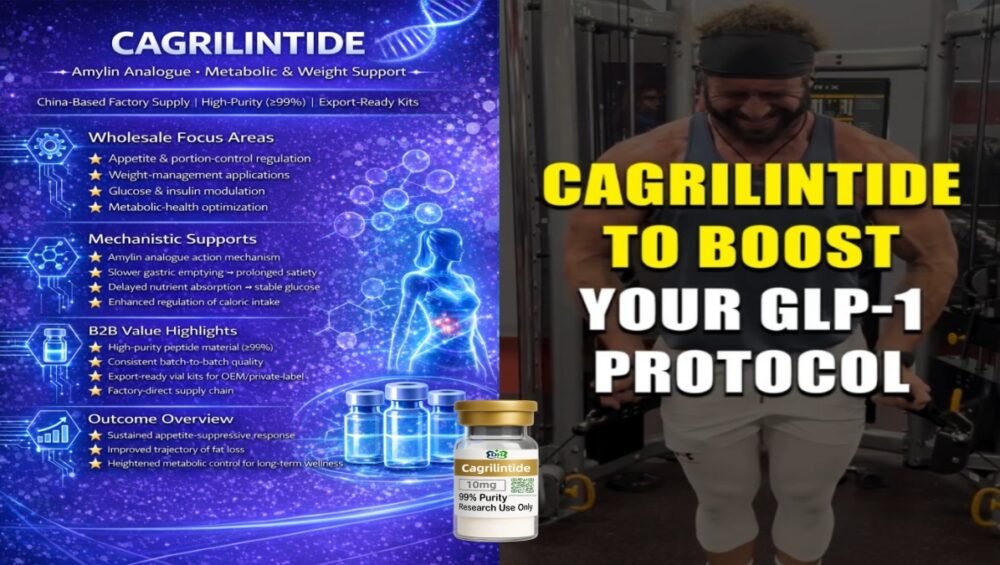
Cagrilintide peptide 10 mg vial and gym training concept

Cagrilintide Wholesale Guide: How Buyers Use This Amylin Analogue in Their Portfolio

What Cagrilintide Adds to a GLP-1 Peptide Portfolio

Cagrilintide is an amylin analogue that many international buyers now treat as a strategic add-on to their GLP-1 portfolios. Compared with classic GLP-1 projects, Cagrilintide research usually focuses on prolonged satiety, delayed gastric emptying and more stable caloric-intake control over time. For wholesale buyers, the key question is not only how it works, but where it fits next to existing GLP-1 materials such as Semaglutide peptide kits.

Mechanistic Role of Cagrilintide

In most study designs, Cagrilintide is positioned as an amylin-pathway support peptide. While GLP-1 projects focus on receptor activation, appetite signalling and glucose handling, Cagrilintide models tend to emphasise:

  • Slower gastric emptying and extended satiety window
  • Reduced meal size and lower snacking frequency over the day
  • Delayed nutrient absorption to smooth post-meal glucose curves
  • Better control of caloric intake in long-running weight-management models

Because of this profile, buyers often use Cagrilintide peptide kits as a tool to fine-tune appetite-control behaviour on top of existing GLP-1 pipelines.

Where Buyers Use Cagrilintide in Their Project Mix

From discussions with B2B customers, Cagrilintide is rarely seen as a first-line molecule. It usually appears in one of these scenarios:

  • Teams already running GLP-1 trials want to explore longer satiety and lower rebound hunger.
  • Portfolios that show good GLP-1 response but uneven caloric-intake control over weeks.
  • OEM / private-label projects looking to differentiate a premium “enhanced satiety” stack.
  • Internal pilot work before committing to larger dual-peptide or triple-pathway strategies.

In other words, Cagrilintide is often treated as a second-step optimisation peptide, layered on top of a GLP-1 foundation rather than replacing it.

Designing Study Protocols Around Cagrilintide

Portfolio design always stays project-specific, but a few patterns appear again and again:

  • Cagrilintide is mapped into models where the team already understands how a GLP-1 peptide behaves; it is rarely added into completely untested designs.
  • Study teams pay close attention to meal timing, food composition and caloric tracking, because that is where amylin-pathway effects are easiest to observe.
  • For OEM work, buyers often plan a two-step roadmap: first single-molecule Cagrilintide, then a dual-peptide option with GLP-1 once internal data looks stable.

This is why many customers start by sourcing a clean, well-documented batch of Cagrilintide kits from a single factory, so that later dual-peptide projects can reuse the same batch history and documentation.

When to Consider Cagrilintide + Semaglutide as a Stack

As portfolios mature, some buyers move from single-molecule Cagrilintide to a fixed dual-peptide stack such as Cagrilintide 5 mg + Semaglutide 5 mg kits. The logic behind this approach is straightforward:

  • Let Semaglutide support GLP-1 receptor activation, hunger signalling and glucose handling.
  • Let Cagrilintide reinforce satiety and caloric-intake control on top.
  • Run both from the same China-based factory to simplify logistics and batch traceability.

Not every buyer needs the dual stack from day one. However, keeping a clear upgrade path toward a combined Cagrilintide + Semaglutide research kit makes it easier to expand projects later without redesigning the whole supply chain.

Handling, Storage and Documentation

From an operational viewpoint, Cagrilintide is handled like other lyophilised peptide vials:

  • Store sealed vials at 2–8 °C in a dry, dark environment.
  • Use reliable cold-room or fridge monitoring so batch conditions stay consistent.
  • Keep COA, HPLC data and internal tracking records aligned for both Cagrilintide and any related dual-peptide kits you plan to introduce later.

For B2B teams, the real value is having a repeatable, export-ready supply chain for all amylin- and GLP-1-related products, instead of one-off spot purchases.

Compliance Notice

THIS CONTENT IS PROVIDED FOR LABORATORY AND R&D DISCUSSION ONLY.

ALL PRODUCTS ARE INTENDED AS RESEARCH CHEMICALS AND ARE NOT LABELED FOR HUMAN USE.

Semaglutide versus tirzepatide versus retatrutide peptide wholesale comparison chart with before and after photo

Semaglutide vs Tirzepatide vs Retatrutide – GLP-1 Wholesale Portfolio Guide

Semaglutide vs Tirzepatide vs Retatrutide – GLP-1 Wholesale Portfolio Guide

For many wholesale buyers, the real question is no longer “Should I look at GLP-1 peptides?” but “How do I design a portfolio around semaglutide, tirzepatide and retatrutide?” Each peptide sits at a different point on the innovation curve, and each attracts a slightly different type of customer or project. This guide focuses on portfolio design, handling basics and supplier planning from a China-based factory perspective.

1. Why Your Catalog Needs More Than One GLP-1 Option

In practice, very few distributors or OEM projects rely on only one GLP-1 peptide. Instead, they build a small family of options so that different clients can choose based on familiarity, budget and research priorities.

  • Semaglutide: widely recognised, single GLP-1 receptor pathway, strong “baseline” option for most portfolios.
  • Tirzepatide: dual GLP-1 / GIP pathway, often positioned as a more advanced metabolic-support option.
  • Retatrutide: triple-receptor peptide acting on GLP-1, GIP and glucagon, typically used as a flagship innovation line.

From a wholesale point of view, this means you can segment your catalog into classic, advanced and frontier options instead of fighting price battles on a single product.

2. Side-by-Side Comparison for Wholesale Planning

PeptidePathway FocusPortfolio RoleTypical Buyer Motivation
SemaglutideSingle GLP-1 receptor activationCore, established GLP-1 lineProven track record, familiar name, easier first step into GLP-1 segment
TirzepatideDual GLP-1 / GIP pathwayUpgrade from classic GLP-1 productsInterest in dual-pathway appetite and metabolic control, “newer” GLP-1 family option
RetatrutideGLP-1, GIP and glucagon receptorsInnovation / flagship GLP-1 peptideBuilding a next-generation pipeline, early mover positioning in triple-receptor research

Thinking in this way helps you decide which peptide should be the “hero” of each campaign, and which ones support it as alternatives or step-up options.

3. When to Lead With Semaglutide, Tirzepatide or Retatrutide

Semaglutide – Baseline GLP-1 Workhorse

  • Best suited for markets where GLP-1 is still relatively new and buyers want a familiar entry point.
  • Helps your catalog look complete without forcing every client into higher-priced advanced options.
  • Useful as a “first trial peptide” before buyers commit to more complex pathways.

Tirzepatide – Dual-Pathway Upgrade

  • Ideal for customers already comfortable with GLP-1 who now want stronger or broader metabolic-pathway coverage.
  • Often framed as a logical next step in weight-management and metabolic support portfolios.
  • Good anchor product for mid-to-high tier price brackets where clients expect more than a single-pathway peptide.

Retatrutide – Triple-Receptor Frontier

  • Targets buyers who are following the latest research on GLP-1, GIP and glucagon combinations.
  • Useful as a “flagship” innovation line for marketing, conferences and long-term OEM planning.
  • Often launched first in small, carefully monitored volumes before scale-up.

In other words, you do not need to pick only one winner. Instead, you design a ladder of options that matches different budgets and risk levels.

4. Handling, Storage and Logistics – What They Have in Common

Although the pathways are different, semaglutide, tirzepatide and retatrutide share many practical handling points at wholesale level:

  • Lyophilized powder format: all three are typically supplied as white or off-white lyophilized peptide powder in glass vials.
  • Export packaging: secure outer cartons, foam or molded inserts, and insulated packaging during long-distance transport.
  • Storage on arrival: buyers normally keep vials sealed, protected from light and moisture, at refrigerated temperatures according to internal SOPs.
  • Reconstitution: always performed under the buyer’s own lab protocols; factories supply the raw material and documentation, not local usage instructions.

For all three peptides, your internal team should run a small pilot batch to verify that warehouse handling, temperature control and documentation workflows are in place before scaling up orders.

5. Pricing, MOQ and Volume Strategy Across the Three Peptides

Because each peptide sits at a different tier, it makes sense to plan pricing and MOQ at portfolio level rather than in isolation.

  • Semaglutide: usually your most accessible option. It often carries lower minimums and is used to build volume and regular re-orders.
  • Tirzepatide: typically priced above semaglutide; minimums may start higher and focus on mid-range to advanced clients.
  • Retatrutide: often launched through limited batches with carefully agreed MOQs, then renegotiated once real demand is proven.

A smart approach is to agree with your factory on step-wise scaling: first test each peptide with pilot orders, then move towards more stable quarter-to-quarter volumes as client feedback becomes clearer.

6. Supplier Questions for a China-Based Factory

Whether you order one or all three peptides, choosing the right supplier matters more than squeezing the last cent out of the quotation. Useful questions to raise early include:

  • What is the factory’s history with GLP-1, GLP-1 / GIP and triple-receptor peptides?
  • Can they provide consistent documentation (COA, HPLC and related batch records) for each peptide?
  • How do they handle production scheduling if you need semaglutide, tirzepatide and retatrutide in the same shipment?
  • What are the realistic lead times for repeat orders and larger OEM runs?
  • Which export routes and packaging setups are recommended for your main markets?

Well-structured answers to these questions reduce risk and make it easier to position your brand as a reliable long-term supplier, not just a reseller.

7. Suggested Launch Roadmap for GLP-1 Portfolios

If you are building a GLP-1 range from scratch, a simple roadmap might look like this:

  1. Phase 1 – Semaglutide foundation: launch semaglutide first to establish a GLP-1 presence and test demand.
  2. Phase 2 – Tirzepatide upgrade: once you have returning GLP-1 clients, introduce tirzepatide as a higher tier option.
  3. Phase 3 – Retatrutide flagship: after your teams and clients are comfortable with dual-pathway products, add retatrutide as an innovation line.

Throughout all three phases, keep the same China-based factory link so that quality, documentation and batch coding remain consistent across the entire GLP-1 family.

Compliance & Use Notice

THIS PRODUCT IS INTENDED AS A RESEARCH CHEMICAL ONLY.

ALL PRODUCTS ARE NOT LABELED FOR HUMAN USE OR MEDICAL TREATMENT.

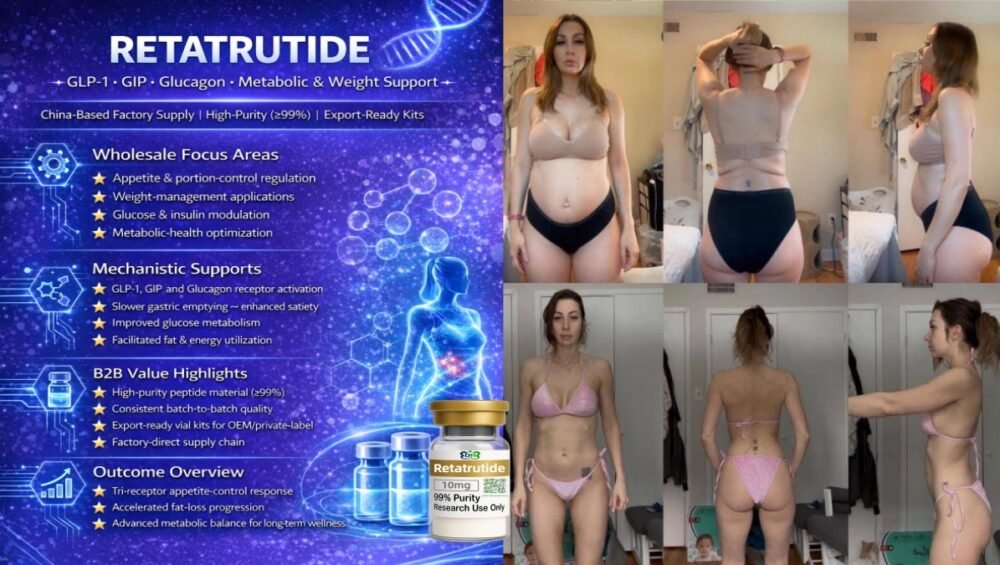
Retatrutide peptide wholesale focus panel with before and after photos

Retatrutide Peptide Wholesale Guide – Triple-Receptor Pathways & Factory Planning

Retatrutide Peptide Wholesale Guide – Triple-Receptor Pathways & Factory Planning

Retatrutide is one of the newest high-interest peptides for metabolic and weight-management research. For wholesale buyers and OEM planners, it is not only a “next-generation GLP-1 option”, but a triple-receptor peptide that acts on GLP-1, GIP and glucagon pathways. This guide focuses on how international buyers can plan retatrutide projects with a China-based peptide factory: from pathway positioning and handling basics, to packaging, documentation and long-term supply planning.

1. Where Retatrutide Fits in Your Wholesale Portfolio

From a portfolio point of view, retatrutide usually does not replace semaglutide or tirzepatide overnight. Instead, buyers tend to treat it as a high-potential addition in the GLP-1 / GIP / glucagon segment.

  • Positioning vs. semaglutide: semaglutide is a single GLP-1 receptor agonist widely used in earlier-generation projects. Retatrutide is often evaluated as a “step-up” option where buyers want broader metabolic-pathway coverage.
  • Positioning vs. tirzepatide: tirzepatide targets GLP-1 and GIP receptors (dual-pathway). Retatrutide adds glucagon-pathway activity on top, so many B2B buyers place it in the “triple-receptor innovation” bucket.
  • Typical demand drivers: clinics and research groups following new GLP-1 / GIP / glucagon literature; buyers preparing next-generation weight-management pipelines; distributors building “future ready” peptide ranges.

Because of this positioning, retatrutide is normally introduced first in pilot volumes, then scaled up as feedback, stability data and market acceptance grow.

2. Key Wholesale Use Cases and Scenarios

Most international clients who request retatrutide from our China-based factory fall into a few clear scenarios:

  • New-generation GLP-1 portfolio launches – adding retatrutide as a “flagship innovation” alongside more established options like semaglutide and tirzepatide.
  • OEM / private-label projects – designing future products where triple-receptor mechanisms are part of the brand story and educational materials.
  • Comparative research projects – labs or institutions that want to compare single, dual and triple-receptor peptides under similar handling conditions.
  • Distributor catalog upgrades – wholesale partners who want their catalog to look “one step ahead” of the market by already listing retatrutide kits.

In each of these scenarios, what buyers care about most is batch consistency, documentation, and supply stability rather than aggressive MOQ discounts. That means factory selection and communication are more important than chasing the very lowest price per vial.

3. Handling, Storage and Stability Basics

Retatrutide is supplied as a lyophilized peptide powder, usually filled into glass vials and sealed for export. Even though your local regulations and protocols will vary, there are a few universal points wholesale buyers should check with any supplier:

  • Cold-chain vs. controlled room-temperature shipping: for most B2B lanes we use secure, insulated packaging with appropriate cooling packs and tracking, then rely on the buyer’s local storage system after arrival.
  • Recommended storage at destination: for warehouse storage, buyers typically keep retatrutide sealed in its original vials, protected from light and moisture, at refrigerated temperatures according to their internal SOPs.
  • Reconstitution guidelines: reconstitution must always follow the buyer’s own lab protocols. Wholesale factories supply the raw lyophilized material and technical data, not local use instructions.
  • Stability documentation: serious B2B projects usually require at least basic stability data and batch-to-batch records. Discuss this before placing larger-volume orders.

Before you scale up, it is wise to run a small pilot batch, validate your local storage and shipping routines, and make sure your team is comfortable handling triple-receptor peptides alongside existing GLP-1 stock.

4. Packaging Options and OEM Planning

For most retatrutide wholesale projects, the base format is a kit of multiple lyophilized vials. Depending on your market and project stage, you may want to discuss:

  • Vial strength and count per kit: some buyers prefer small units for testing; others want larger kits to support ongoing projects. These can be customized during OEM discussions.
  • Neutral vs. private-label packaging: early orders often use neutral export cartons with basic labeling. Once the project is stable, buyers move to fully branded boxes, inserts and artwork.
  • Batch coding and traceability: clear batch numbers, manufacturing dates and internal tracking codes are essential for triple-receptor peptides that may be used in long-term projects.
  • Documentation bundle: COA, HPLC and related documentation should match what your regulatory and quality teams expect for pharmaceutical-grade peptide material.

It is usually easier to keep the first two or three orders in a standard, neutral format, then lock in OEM details once you are confident about retatrutide’s role in your portfolio.

5. Pricing, MOQ and Long-Term Supply Strategy

Because retatrutide sits in a more advanced technology tier than classic GLP-1 peptides, pricing is naturally higher. Instead of chasing the lowest possible number, most experienced buyers focus on:

  • Transparent cost structure: understanding how vial strength, kit size and documentation requirements affect the quotation.
  • Reasonable MOQ for trials: agreeing on a starting MOQ that allows real-world feedback without over-committing capital.
  • Step-wise scaling plan: mapping out how price and terms evolve as your monthly or quarterly volume increases.
  • Backup batches and lead times: aligning production slots and shipping windows with your own launch schedule.

For serious projects, it is always better to work directly with a China-based factory that can provide both wholesale pricing and clear communication on lead times, instead of relying only on resellers who have limited control over supply.

6. Comparing Retatrutide with Semaglutide and Tirzepatide

In practice, buyers rarely choose “retatrutide versus everything else”. The more realistic question is how to combine retatrutide with existing GLP-1 options.

  • Semaglutide: highly established, strong recognition, often kept in the catalog for stability and price reasons.
  • Tirzepatide: dual GLP-1 / GIP pathway, widely seen as a key upgrade from older single-pathway products.
  • Retatrutide: triple-receptor mechanism adds glucagon activity, making it attractive for buyers who want the “frontier” of metabolic-pathway innovation.

Many distributors end up offering all three peptides with slightly different messaging, pricing tiers and kit sizes, so customers can choose based on their own priorities.

7. How to Brief a China-Based Factory for Retatrutide

To save time on email back-and-forth, it helps to send a clear, one-page brief when you first contact a factory about retatrutide:

  • Project type: catalog listing, OEM / private label, pilot research project, or long-term wholesale supply.
  • Target markets: which countries or regions you plan to serve, and any specific documentation you need.
  • Preferred vial strength and kit size: even a rough idea (for example “small trial kits first, then larger kits later”) is useful for quotation.
  • Estimated starting volume: monthly or quarterly units you’d like to test in the first 3–6 months.
  • Timeline: expected launch window, and whether you already sell semaglutide or tirzepatide.

With this information, a serious factory can respond faster with realistic options on pricing, lead time and available documentation, instead of generic answers.

Compliance & Use Notice

THIS PRODUCT IS INTENDED AS A RESEARCH CHEMICAL ONLY.

ALL PRODUCTS ARE NOT LABELED FOR HUMAN USE OR MEDICAL TREATMENT.

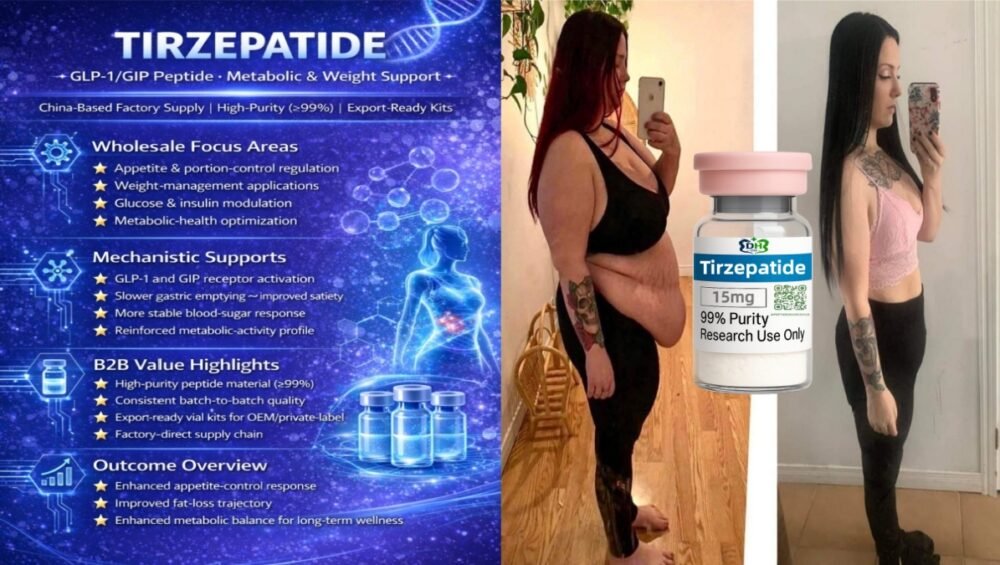
Tirzepatide GLP-1 GIP peptide 15 mg vial with weight-change before-and-after photos

Tirzepatide Wholesale Strategy Guide: GLP-1/GIP Peptide Portfolio Playbook

Tirzepatide wholesale overview for GLP-1/GIP portfolios

Tirzepatide has rapidly moved from a “new GLP-1/GIP molecule” into a core component of many high-demand peptide portfolios. For wholesale buyers and project owners, the key questions are how Tirzepatide should sit beside Semaglutide and other GLP-1 analogues, and how to manage factory relationships, pricing and logistics when demand is volatile.

This guide looks at Tirzepatide from a strategy and planning perspective rather than just as a single product. The focus is on portfolio design, documentation, export routes and supplier selection when working with a China-based peptide factory.

1. Why Tirzepatide matters beyond Semaglutide

Most buyers first enter the GLP-1 space through Semaglutide. Tirzepatide then becomes the next step when they want to expand their lineup or respond to requests for dual GLP-1/GIP research projects.

  • Extended mechanism: Tirzepatide combines GLP-1 and GIP receptor activity in one molecule, which is attractive for research teams exploring multi-pathway approaches.
  • Portfolio differentiation: carrying both Semaglutide and Tirzepatide helps distributors and brands avoid looking like “single-molecule shops”.
  • Risk spreading: demand can rotate between molecules; having both in stock helps smooth overall business instead of depending on a single GLP-1 peptide.

From a factory perspective, Tirzepatide is often produced in the same or related manufacturing environments as Semaglutide. That means documentation standards and quality expectations can be aligned across both peptides.

2. Typical Tirzepatide formats and kit structures

On the wholesale side, Tirzepatide is usually supplied as a high-purity (≥99%) lyophilized peptide powder in clear glass vials, labeled strictly for research use. Exact strengths may vary, but kit structures generally follow a few practical patterns.

  • Vial strengths: factories may offer several vial strengths so that different research teams can choose the most convenient option.
  • Standard kit size: 10-vial kits remain a common baseline for both pilot orders and repeat supply, mirroring how many buyers structure their Semaglutide kits.
  • Artwork: neutral factory labels for bulk buyers, with optional OEM or private-label branding for projects that need their own identity.

When planning a Tirzepatide kit, it helps to mirror the logic you already use for Semaglutide: fix your preferred vial size, confirm cap and stopper details, then agree on carton and outer packaging so that both molecules travel well in the same shipment.

3. Documentation, COA and portfolio-level quality control

Because Tirzepatide will usually be compared directly with Semaglutide in buyer conversations, documentation quality is not just a regulatory formality – it becomes part of your brand positioning.

  • COA essentials: identity testing, purity (ideally ≥99%), related-peptide profile, residual solvents and water content.
  • Batch alignment: similar layouts and parameter sets across Semaglutide, Tirzepatide and other GLP-1 analogues make internal comparisons easier.
  • Supplementary docs: method overviews, QC summaries or stability comments for buyers who need deeper technical reassurance.

For portfolio planning, many distributors now insist on having at least one representative COA for each GLP-1 peptide before negotiating serious volumes. A factory that can provide clear documents for both Semaglutide and Tirzepatide is generally better positioned for long-term cooperation.

4. Pricing structures and quote logic for Tirzepatide

Tirzepatide pricing can feel more volatile than classic peptides because it is tied to high-profile market demand. Instead of trying to force a single fixed price, it is usually more productive to negotiate a structure with your factory.

  • Volume tiers: separate prices for pilot, mid-volume and true bulk orders, with clear thresholds and validity periods.
  • Portfolio bundles: some manufacturers are open to combined pricing when Semaglutide, Tirzepatide and other GLP-1 peptides are planned together.
  • Service add-ons: artwork design, customized labels or special logistics routes should be quoted separately from the base peptide cost.

When you ask for a Tirzepatide quote, include realistic ranges rather than a single number – for example, a starting volume, a potential scale-up volume and whether you might add other GLP-1 peptides into the same purchase window.

5. Export routes, packaging and lead times

From a logistics standpoint, Tirzepatide kits are typically handled as research-use-only peptide materials, similar to Semaglutide. However, because demand can be very time-sensitive, planning the route is as important as choosing the molecule.

  • Export packaging: shock-absorbing inner trays, sealed kits and moisture control for vials, packed in export-ready cartons.
  • Regional routes: separate lanes for North America, Europe, UK or other regions, depending on your risk tolerance and time expectations.
  • Lead-time expectations: professional suppliers usually share processing and dispatch updates within around three business days after payment for regular batches.

For more complex projects, it can be useful to ask for example tracking numbers or anonymized screenshots from previous shipments. This gives you a realistic view of how your Tirzepatide parcels are likely to move.

6. Supplier selection and risk control for Tirzepatide

Because Tirzepatide is a high-value peptide, weak due diligence can become costly very quickly. A simple but disciplined checklist makes it easier to filter potential factories and trading companies.

  • Identity and track record: look for verifiable company details, not just chat IDs or generic web pages.
  • Document consistency: check that COA data, packaging photos and batch information all align logically.
  • Trial order strategy: structure pilot orders at a size that gives meaningful feedback without over-exposing your budget.
  • Payment terms vs risk: align your payment method with how well you know the supplier and how critical the shipment is.

A good Tirzepatide supplier will not resist reasonable questions. The tone and clarity of their replies are often as important as the actual numbers on the quote sheet.

7. Positioning Tirzepatide alongside other GLP-1 peptides

In practice, few portfolios carry Tirzepatide alone. Most wholesale buyers plan it as part of a family that also includes Semaglutide, Retatrutide, Survodutide or Cagrilintide-based blends.

  • Anchor-and-extension model: Semaglutide remains the anchor GLP-1 peptide, while Tirzepatide acts as a higher-complexity extension for selected projects.
  • Combination planning: some buyers use Cagrilintide + Semaglutide blends in parallel with Tirzepatide to cover different research preferences.
  • Factory consolidation: working with one competent factory for the whole GLP-1 family can simplify QC, logistics and communication.

FAQ: Tirzepatide wholesale planning from a China-based factory

Q1. Is this guide about medical use or dosing?

No. This article focuses only on B2B wholesale planning, portfolio structure and supplier selection. It does not provide medical advice, dosing instructions or recommendations for patient use.

Q2. Are Tirzepatide products discussed here sold for human consumption?

No. Tirzepatide and other peptides mentioned are supplied strictly as research materials. They are not labeled or promoted for human consumption, therapy or diagnostic use.

Q3. Can I use the same factory for Tirzepatide and Semaglutide?

In many cases, yes. If a manufacturer already has a stable process for Semaglutide, they may also be equipped to support Tirzepatide and other GLP-1 analogues, which simplifies QC and logistics for your portfolio.

Q4. How should I handle price changes over time?

It is reasonable to agree on volume tiers and validity periods rather than expecting one fixed price forever. Keep communication open with your supplier and review pricing when volumes or market conditions change significantly.

DISCLAIMER: This article is intended for B2B wholesale and research-chemical planning only. It does not provide medical advice, dosage guidance or recommendations for human use.

All products discussed are supplied as research materials only and are not labeled for human consumption or medical use.

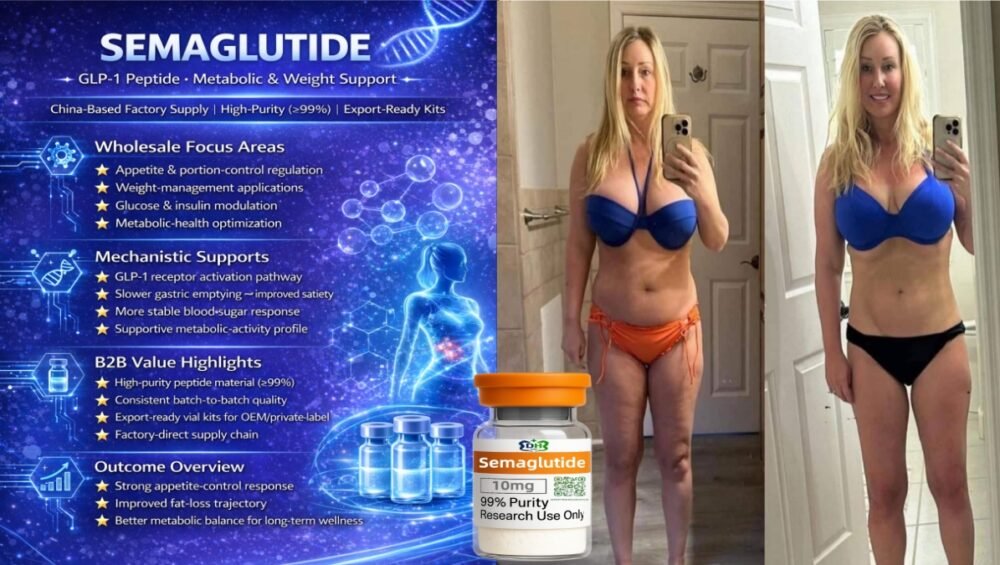
Semaglutide GLP-1 peptide 10 mg vial with before-and-after body photos

Semaglutide Peptide Wholesale Guide: China Factory Supply & GLP-1 Portfolio Planning

Semaglutide peptide wholesale overview

Semaglutide has become one of the highest-demand GLP-1 peptides in the global market. For factory-facing and wholesale buyers, the key questions are no longer “what is it”, but rather how to structure stable supply, manage quality documentation and keep export logistics under control when working with a China-based peptide factory.

This guide walks through the Semaglutide peptide from a wholesale and B2B perspective: where it usually sits in a GLP-1 portfolio, which formats are most practical, what to check on COA and batch docs, and how to talk about pricing, routes and risk with your supplier.

1. What Semaglutide means in a GLP-1 wholesale portfolio

For most distributors and project owners, Semaglutide is the anchor of a GLP-1 product family. It often sits next to Tirzepatide, Retatrutide, Survodutide or Cagrilintide-based blends and is used as the reference point for quality, pricing and demand forecasts.

  • Demand driver: high global interest around GLP-1 research and weight-management related projects.
  • Role in your lineup: a core GLP-1 peptide that can support both retail-facing brands and B2B formulation projects.
  • Benchmark molecule: many buyers use Semaglutide as the benchmark when comparing other GLP-1 analogues.

Because Semaglutide is so visible, the way you source it from a factory will strongly influence how buyers perceive the rest of your GLP-1 range.

2. Common Semaglutide research formats & kit structures

On the wholesale side, Semaglutide is usually supplied as a high-purity (≥99%) lyophilized peptide powder in clear glass vials. Exact strengths vary by supplier, but kit structures typically follow a few familiar patterns.

  • Typical vial strengths: small to medium milligram amounts per vial, suitable for research-use-only projects.
  • Standard kit size: many factories offer 10-vial kits as a base configuration, which is convenient for sampling and distribution.
  • Labeling and artwork: neutral factory artwork for bulk buyers, or OEM / private-label designs for brand owners.

When you discuss formats with a factory, it is useful to separate three layers clearly:

  1. Core peptide spec: purity level, peptide content, residual solvent and related-peptide profile.
  2. Vial and kit format: vial size, stopper and cap color, number of vials per kit, carton style.
  3. Brand layer: whether you need plain factory labels or custom OEM artwork for your own brand.

3. Quality, COA and batch documentation for Semaglutide

Because Semaglutide is a high-profile peptide, buyers should treat documentation as non-negotiable. Ask the factory to show you a representative certificate of analysis before committing to large orders and make sure your contract mentions documentation per batch.

  • Core COA items: identity testing, purity (preferably ≥99%), related substances, water content and residual solvents.
  • Batch traceability: clear batch numbers, manufacturing dates and internal reference codes.
  • Stability notes: recommended storage conditions (normally 2–8 °C, protected from light and moisture).

For larger or recurring projects, many buyers also request supplementary documents such as method summaries, technical data sheets or brief QC process descriptions. The more clearly this is defined at the start, the smoother future shipments tend to be.

4. Shipping, export routes and packaging from China

From a logistics perspective, Semaglutide kits are usually shipped as non-finished, research-use-only peptide materials. That means routing and packaging decisions are just as important as the peptide itself when you work with a China-based factory.

  • Packaging: export-ready boxes with shock-absorbing inserts, sealed kits and moisture protection for the vials.
  • Routes: different lines may be used for different regions (for example, one route for North America and another for EU / UK).
  • Temperature handling: discuss realistic transport conditions and whether your lane needs additional insulation or faster transit times.

Professional suppliers typically provide tracking once parcels are processed. A reasonable expectation is that processing and dispatch updates are provided within around three business days after payment for regular batches.

5. Semaglutide wholesale pricing, MOQs and quote requests

Semaglutide pricing can move faster than most classic peptides, so buyers should treat quotes as time-sensitive and always ask what factors influence future price changes. Instead of pushing only for the lowest number, it is often more useful to focus on structure and transparency.

  • Clarify volume tiers: ask how pricing changes between pilot orders, mid-size orders and full-scale bulk runs.
  • Separate core cost and services: distinguish between pure peptide cost and optional extras such as OEM artwork, custom packaging or special logistics routes.
  • Ask for example quotes: request a few concrete scenarios (for example, different kit counts or mixed GLP-1 orders) so you can compare offers cleanly.

When you email a factory for Semaglutide quotes, include at least: intended order size range, preferred vial / kit format, target region for shipping and whether you plan to repeat orders if the first batch performs well.

6. Risk control when choosing a Semaglutide supplier

Because Semaglutide is a high-demand item, the market also attracts opportunistic traders. A basic risk-control checklist can protect your budget and reputation.

  • Check identity: verify company details, registration information and basic track record, not just a chat handle.
  • Cross-check documentation: look for inconsistencies across COA, packaging photos and communication.
  • Start with realistic pilot orders: avoid committing your full annual budget on the first shipment.
  • Align payment terms with risk: safer routes and factories with a history of on-time deliveries may justify more flexible terms; unknown suppliers usually do not.

Serious factories understand that B2B buyers need to ask detailed questions. The way a supplier responds to structured questions about Semaglutide is often a good indicator of how they will handle future GLP-1 projects for you.

7. How Semaglutide fits with other GLP-1 peptides

Most wholesale portfolios do not carry Semaglutide alone. Instead, it is positioned inside a small GLP-1 family that might also include Tirzepatide, Retatrutide, Survodutide or Cagrilintide-based blends. Working with one factory for the full GLP-1 lineup can simplify quality control and logistics.

  • Shared specs: similar purity expectations and documentation formats across multiple GLP-1 peptides.
  • Coordinated production: the factory can align production windows to prepare mixed GLP-1 shipments.
  • Portfolio-level pricing: some suppliers provide better overall conditions when buyers plan a structured GLP-1 lineup instead of isolated one-off orders.

FAQ: Semaglutide wholesale from a China-based factory

Q1. Is this article giving dosing or medical advice?

No. This guide focuses only on B2B wholesale planning, supply-chain structure and documentation. It does not provide dosing instructions, medical guidance or patient recommendations.

Q2. Are Semaglutide products discussed here sold for human use?

No. Semaglutide and other peptides mentioned are supplied strictly as research materials. They are not labeled or promoted for human consumption, therapy or diagnostic use.

Q3. Can one factory handle my whole GLP-1 lineup?

In many cases, yes. If the manufacturer already produces Semaglutide, they may also support Tirzepatide, Retatrutide, Survodutide or related combinations. Consolidating your GLP-1 portfolio at a single factory can simplify quality control and logistics discussions.

Q4. How often can pricing change for Semaglutide?

Pricing can move with raw material cost, demand and regulatory factors. It is reasonable to confirm that each quote has a validity period and to review conditions again before placing significantly larger orders.

DISCLAIMER: This article is intended for B2B wholesale and research-chemical planning only. It does not provide medical advice, dosage guidance or recommendations for human use.

All products discussed are supplied as research materials only and are not labeled for human consumption or medical use.

en_USEN
Select the fields to be shown. Others will be hidden. Drag and drop to rearrange the order.
  • Image
  • SKU
  • Rating
  • Price
  • Stock
  • Availability
  • Add to cart
  • Description
  • Content
  • Weight
  • Dimensions
  • Additional information
Click outside to hide the comparison bar
Compare
📞 Contact Us
WhatsApp Email Telegram
Shopping cart close